
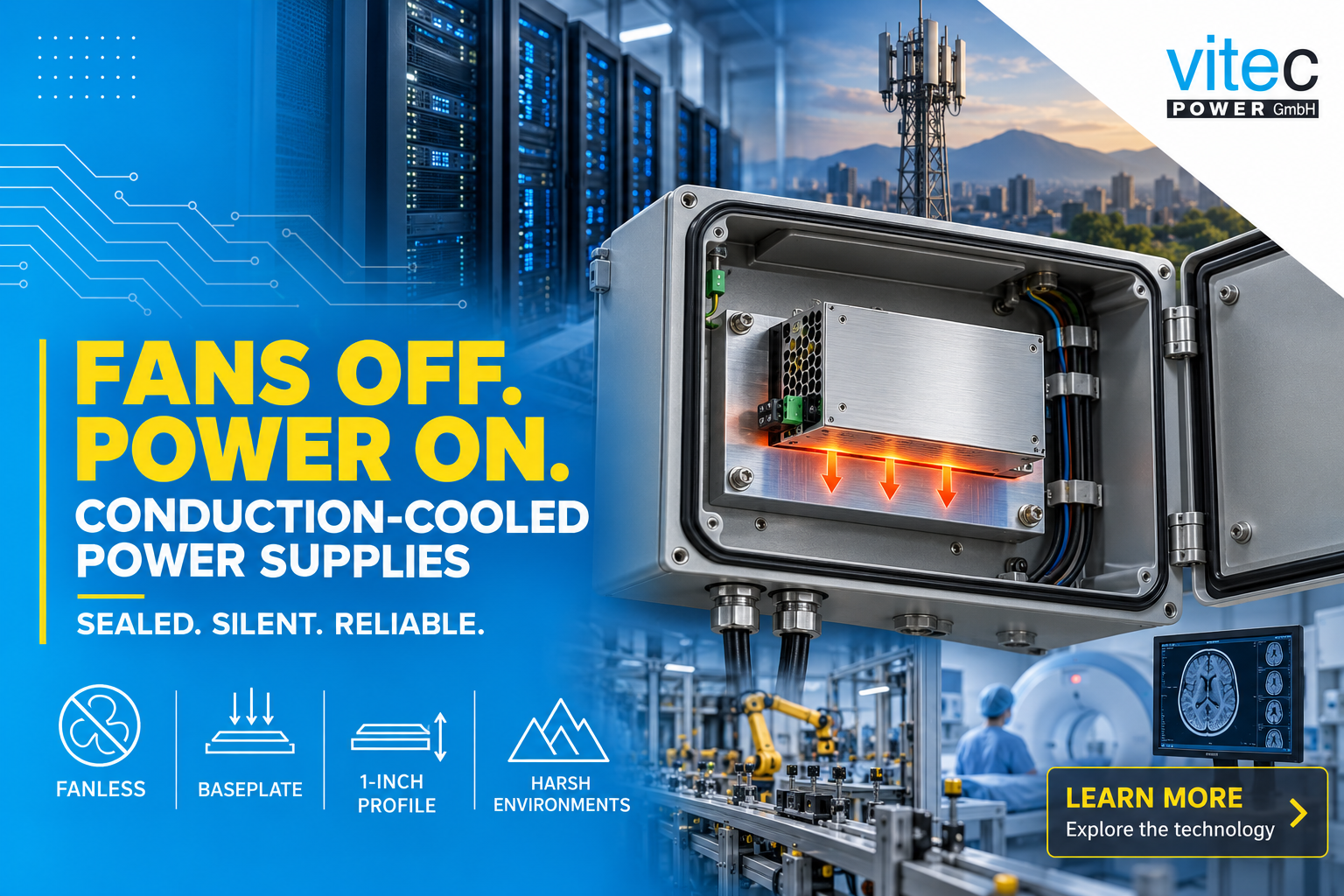
Fans Off, Power On: Conduction-Cooled Power Supplies for Sealed Enclosures
Heat is one of the most critical design challenges in sealed and fanless electronic systems. Without active airflow, the thermal energy generated by a power supply can accumulate inside the enclosure, increasing component temperatures and potentially reducing system reliability and service life.
Cincon’s fanless power supplies address this challenge through advanced conduction cooling. Instead of depending on a fan to move warm air away from the power supply, heat is transferred through a thermally optimized baseplate to the system chassis or an external cold plate.
The result is a compact and reliable power architecture without fan noise, moving parts or unfiltered airflow.
What Is a Conduction-Cooled Power Supply?
A conduction-cooled power supply transfers internally generated heat through direct physical contact with a thermally conductive surface. In a typical installation, the power supply baseplate is mounted to the metal chassis of the equipment.
The chassis then functions as part of the thermal management system by absorbing and dissipating the heat.
This approach is particularly valuable when conventional airflow cooling is impractical, undesirable or impossible.
Why Use Conduction Cooling in a Sealed Enclosure?
Removing the fan can deliver several system-level benefits:
- No mechanical fan noise
- No fan wear or fan-related maintenance
- Reduced ingress of dust and airborne contaminants
- Greater flexibility for sealed enclosure designs
- Improved suitability for harsh industrial environments
- More predictable heat transfer through a defined thermal interface
However, fanless does not mean that thermal management is unnecessary. The enclosure, mounting surface, thermal interface material and ambient operating conditions must all be considered during system design.
CFM or LFM: Which Series Fits the Application?
Cincon offers two complementary product families for conduction-cooled applications.
CFM Series: A Versatile Conduction-Cooled Platform
The CFM Series provides a robust foundation for industrial and other demanding applications. Depending on the selected model, the portfolio covers a broad range of power levels and output voltages.
CFM power supplies are an appropriate choice when designers need a reliable baseplate-cooled solution with flexible mechanical and electrical options.
Typical applications include:
- Industrial computers
- Robotics and automation
- Telecommunications equipment
- Network infrastructure
- Energy storage systems
- Substations
- Medical display and lighting systems
LFM Series: High Power Density in a 1-Inch Profile
The LFM Series is designed for systems where installation height and thermal performance are especially important.
Its main design characteristics include:
- 1-inch low-profile construction: Suitable for compact and height-restricted systems.
- Semi-potted structure: The potting material supports heat transfer from critical components toward the baseplate while also improving mechanical robustness.
- Baseplate cooling: Heat can be conducted directly into the equipment chassis.
- Liquid-cooling compatibility: The flat, low-profile architecture can be integrated with a suitably engineered liquid cold plate.
- Multiple power classes: Industrial LFM models are available from 200 W to 550 W, with medical variants also included in the portfolio.
This combination makes the LFM Series particularly suitable for compact systems that require high power density without relying on forced-air cooling.
Where Are Fanless Power Supplies Used?
Conduction-cooled power supplies are relevant wherever airflow is restricted or system reliability is a priority. Common application areas include:
- Edge-computing platforms
- Industrial control systems
- 5G telecommunications equipment
- Network firewalls
- Autonomous and robotic systems
- Drones and remotely operated vehicles
- Railway and substation electronics
- Medical equipment
- Outdoor and sealed electronic systems
The appropriate power supply must always be selected according to the required output power, input range, output voltage, safety approvals, ambient temperature and available cooling surface.
What Must Engineers Consider During Integration?
A successful conduction-cooled design depends on the complete thermal path—not only on the power supply.
Engineers should evaluate:
- The maximum power loss under realistic operating conditions
- The permitted baseplate temperature
- The flatness and size of the mounting surface
- The thermal resistance of the interface material
- The chassis material and heat-spreading capability
- The maximum ambient temperature
- Power derating at elevated temperatures
- Air gaps and mechanical mounting tolerances
Thermal simulation and prototype measurements are strongly recommended. Testing the final enclosure under worst-case input voltage, load and ambient-temperature conditions helps verify that all specified temperature limits are maintained.
Discuss Your Power and Thermal Requirements
Selecting a fanless power supply requires close coordination between electrical, mechanical and thermal design. We can help identify the appropriate CFM or LFM solution for your operating environment, available installation space and required power level.
Contact the Cincon team at [email protected] to discuss your next design.
