
Powering AI’s Arteries—High-Bandwidth Optical Module Testing
As the demand for data processing capacity continues to surge with the rapid development of AI large models, petabyte-level data throughput per second is becoming increasingly common. Interconnect bandwidth in data centers is rapidly evolving from 400G to the 1.6T era, making optical communication the “compute backbone” of the digital world.
However, the doubling of bandwidth comes with a significant increase in power consumption. Taking OSFP optical modules as an example, their power consumption continues to rise with each new generation. The maximum power consumption of 800G modules reaches 33 W, while 1.6T modules have surged to 42.9 W.
Even with advanced 200G-per-lane technologies, where energy efficiency can be controlled at approximately 17 pJ/bit, the operating power consumption of a 1.6T optical module still reaches around 27.2 W, according to the formula:
Power Consumption (W) = Total Data Rate (bit/s) × Energy Efficiency (pJ/bit)
The dramatic increase in power consumption not only introduces significant thermal management challenges but also places unprecedented demands on power supply stability and testing efficiency.

Three Core Requirements for Optical Module Electrical Testing
Electrical performance testing of optical communication modules directly affects signal integrity and bit error rate (BER), placing stringent requirements on programmable DC power supplies.
Typical optical modules operate at a 3.3 V supply voltage, while operating current and power consumption vary depending on packaging technology and transmission rate. Therefore, multidimensional testing is required during both R&D validation and production testing.
The three key requirements include:
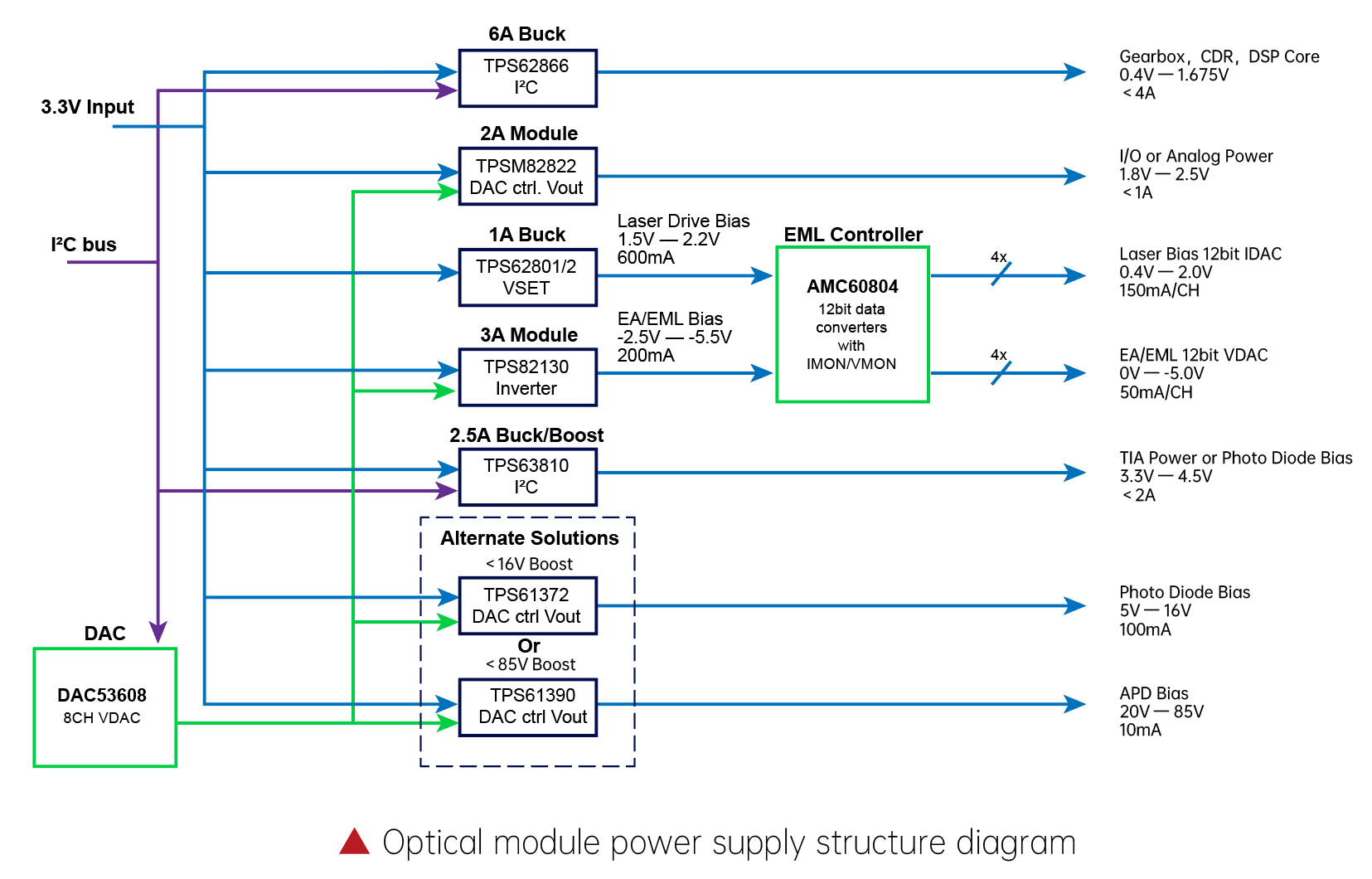
Table Output with Ultra-Low Ripple and Noise
High-speed optical modules are extremely sensitive to power supply noise. Excessive ripple can directly degrade signal quality.
According to common industry specifications, ripple and noise are typically required to be controlled within 100 mVp-p, while high-precision R&D environments demand even stricter limits.
Multi-Channel Testing to Improve Mass Production Efficiency
Optical module production requires extensive aging tests and performance validation. Traditional single-channel power supplies occupy large space and involve complex wiring, making them unsuitable for high-volume manufacturing environments that demand higher testing efficiency.
Comprehensive Coverage of Benchtop and Rack-Mount Systems
During the R&D and validation stage, engineers prefer benchtop power supplies for flexibility and ease of operation. In contrast, rack-mount power supplies are more suitable for production testing due to their high-density integration, enabling different testing scenarios to be addressed efficiently.
NGI Testing Solutions Precisely Address Industry Pain Points
To address these challenges, NGI provides a comprehensive range of programmable DC power supply solutions that directly tackle key testing requirements through advanced technical capabilities and scenario-based adaptability.
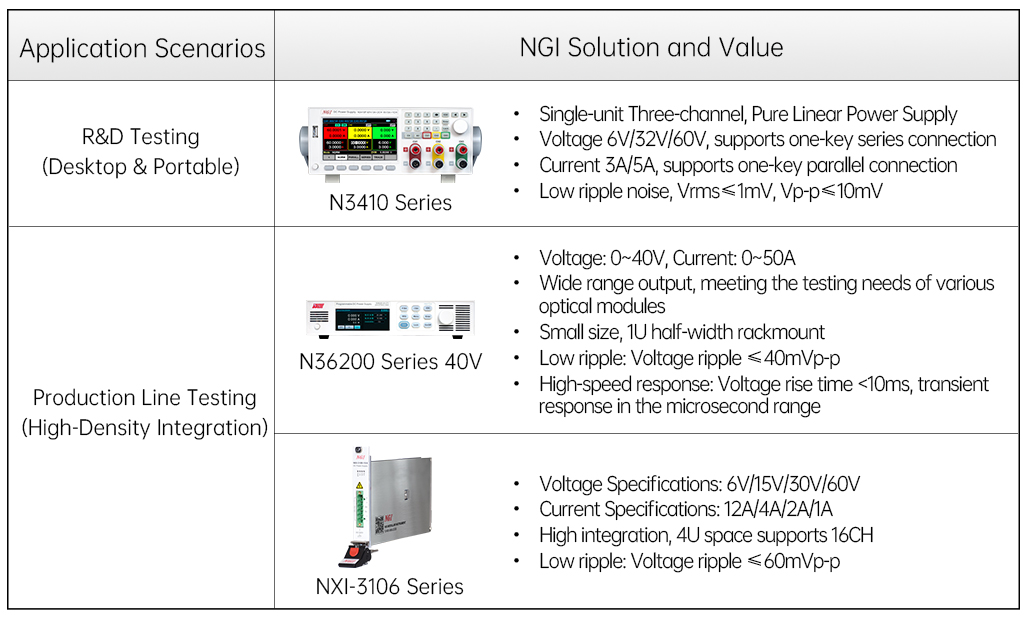
Looking ahead, optical communication technology standards continue to evolve rapidly. Emerging standards such as IEEE 802.3df and OSFP MSA impose increasingly stringent requirements on module performance. As the industry moves toward 3.2T and even higher bandwidth, testing equipment must offer greater programmability, precision, and system integration.
NGI will continue to develop advanced solutions tailored for optical module electrical testing, delivering higher accuracy, lower noise, and smarter automation capabilities to support the rapid development of the optical communication industry and safeguard the uninterrupted operation of the digital world’s “compute backbone.”
With the explosive growth of the artificial intelligence industry, the AI server market is experiencing unprecedented expansion. Leveraging years of experience in the data center energy sector, NGI provides comprehensive power testing solutions for AI servers, enabling full-scenario testing capabilities and supporting the continued advancement of the industry.
